WHAT ARE MUTUAL FUNDS ?
Mutual Funds in India are structured as trusts under the Indian Trusts Act, 1882, and operate in accordance with the regulations laid down by the Securities and Exchange Board of India (SEBI). A mutual fund is an investment vehicle that pools money from multiple investors and invests it across a range of asset classes such as equities, bonds, precious metals, government securities and money market instruments.
These investments are managed by professional fund managers in line with the scheme's objective. The returns generated are distributed proportionately among investors after deducting applicable expenses and are reflected through the scheme's Net Asset Value (NAV). The fees charged for managing mutual funds are regulated and subject to limits defined by SEBI, ensuring transparency and investor interest remain at the core.
Myth Vs Fact about Mutual Funds
Myth : Mutual Funds are only for long term investments.
Fact: Mutual Funds offer a wide range of investment options suited for short term, medium term and long term goals, ranging from overnight funds to solutions designed for long term wealth creation and retirement planning.
Myth : Mutual Funds guarantee high returns.
Fact: Returns from equity instruments are market linked and depend on the performance of underlying assets and time horizon.
Myth : All Mutual Funds are risky.
Fact: Risk varies across mutual funds, ranging from relatively low risk debt funds to higher risk equity funds. The choice of asset class plays a crucial role in achieving an investor's financial goals. Debt funds typically prioritize capital preservation along with steady income generation, whereas equity funds aim for higher growth over the long term.
Risk often arises when investors select schemes solely based on past performance, without fully understanding the underlying risks or aligning the investment with their own financial objectives.
Myth : Past performance ensures future returns.
Past performance is not a guarantee and should not be the sole basis for investment decisions. Market conditions, economic cycles, and fund strategies evolve over time, which can impact future returns. In fact, regulators mandate a standard disclaimer in all communications stating that "past performance may or may not be sustained in future and is not a guarantee of any future returns."
Categories of Mutual Funds
Mutual funds are broadly classified into three categories based on the underlying asset class and their composition:
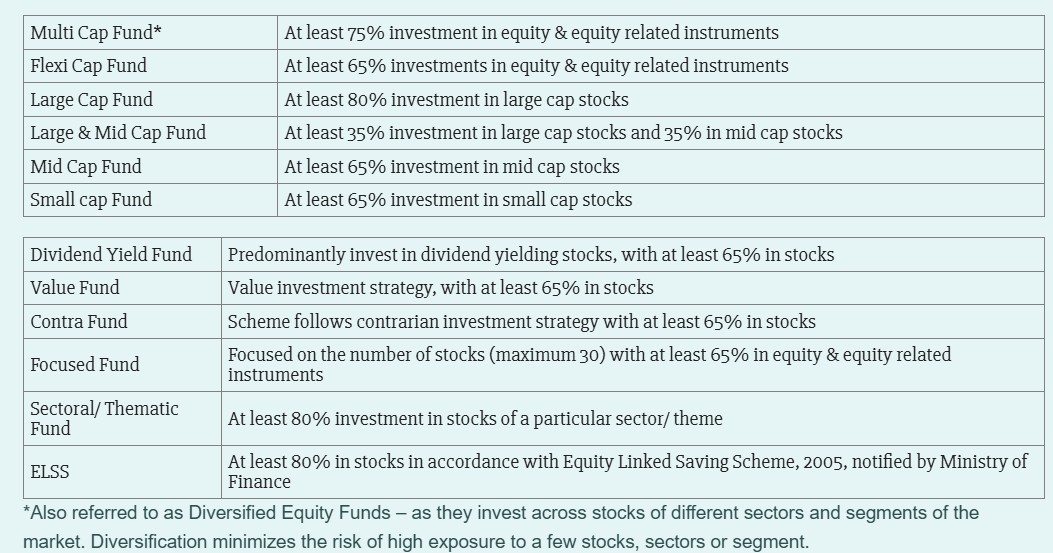
Equity Funds : These mutual fund schemes invest in equity and equity related securities. Equity funds have sub-categories based on the market cap segments, where the scheme may primarily invest in e.g. large cap, large and midcap, midcap, small cap, multicap, flexicap etc. The primary investment objective of equity funds is capital appreciation.
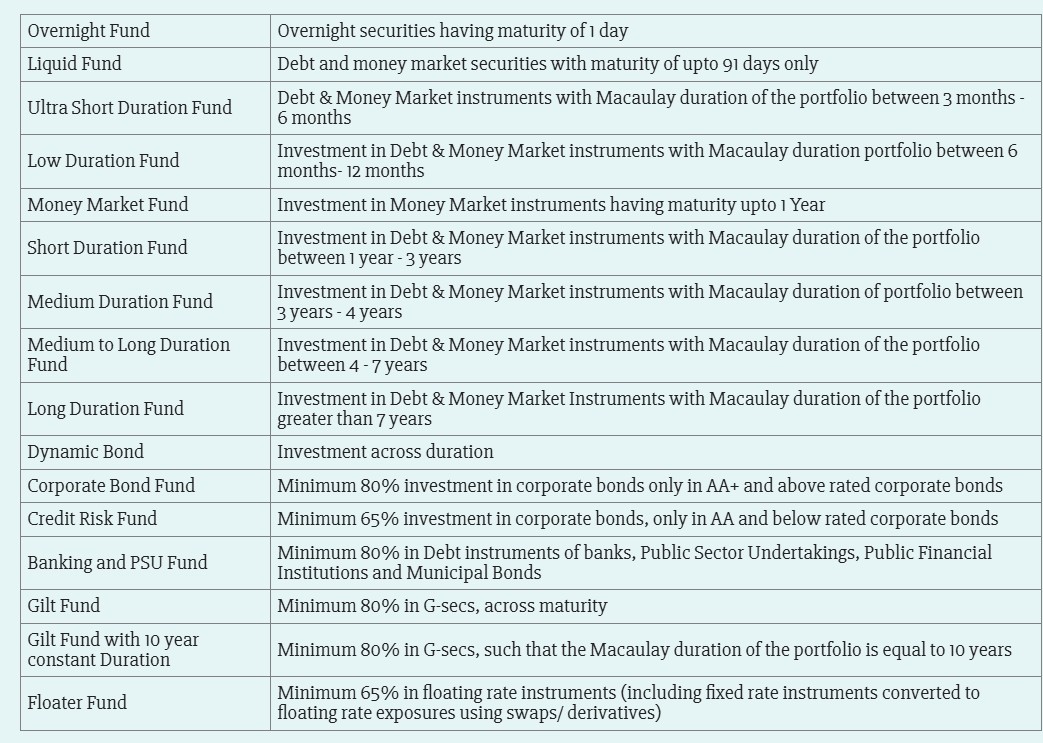
Debt Funds : These mutual funds schemes invest in debt and money market instruments. Debt funds have sub-categories based on the maturity profiles of the underlying debt or money market instruments e.g. overnight, liquid, ultra-short duration, low duration, short duration, medium duration, long duration etc. The primary investment objective of equity funds is capital appreciation.
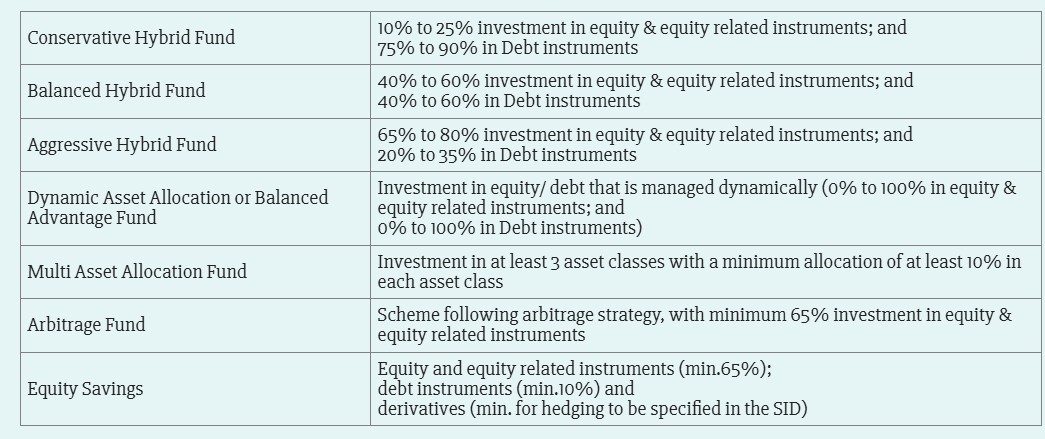
Hybrid Fund : These funds invest in both equity and debt securities. They may also invest in other classes like gold, REITs, InvITs etc. The primary investment objective of hybrid funds is asset allocation. Different types of hybrid funds include aggressive hybrid funds, conservative hybrid funds, balanced advantage funds, equity savings etc.
Below are the detailed guidelines and rationalization of the schemes As perSEBI.
Equity Funds :
Debt Funds :
Hybrid Funds :